Examples#
The following table gives an overview over all examples.
Section |
Brief Description |
File |
|---|---|---|
This example shows how to use multiple adaptive time step methods |
||
This example shows how to use random in an ODE |
||
The chemistry example of Brusselator (2 equations model) |
||
This example shows hos to use DIRK methods |
||
This example shows how to use range and iterators on solution |
||
This example shows how to use exponential Runge-Kutta methods |
||
This example is the simplest example |
||
An example of splitting and exact solver |
||
The classical heat equation solving with RKC2 method |
||
This example shows how to use ROCK2 and ROCK4 methods |
||
This example shows how to coupling ponio and samurai |
||
The chaotic system example of Lorenz equations |
||
This example shows how to use splitting methods and Lawson methods |
||
This example shows how to use all methods (except expRK) |
||
The classical predator–prey model of Lotka-Volterra |
||
Example of a traveling wave |
||
The classical pendulum equation |
||
Solves Belousov-Zhabotinsky equations with PIROCK method |
||
Solves Belousov-Zhabotinsky equations with PIROCK method in 2D |
To lunch examples, in the main directory of ponio run:
cmake . -B build -DBUILD_DEMOS=ON
Eventually to get examples with samurai run:
cmake . -B build -DBUILD_DEMOS=ON -DBUILD_SAMURAI_DEMOS=ON
and
cd build
next you can compile an example with
make AN_EXAMPLE
you could also launch the Python script which launch the example and display results
make AN_EXAMPLE_visu
or
make visu_AN_EXAMPLE
Arenstorf orbit#
The system of differential equations for the Arenstorf orbit are:
where
parameter \(\mu=0.012277471\) and the initial condition gives by:
To solve this kind of problem with ponio, first of all you should rewrite it as the form: \(\dot{u} = f(t, u)\), here we classically take
So we have:
In this example we solve this system with some explicit adaptive time step methods from Dormand, J.R., Prince, P.J., A family of embedded Runge-Kutta formulae (1980) Journal of Computational and Applied Mathematics
Arenstorf orbit |
Arenstorf velocity |
|---|---|
|
|
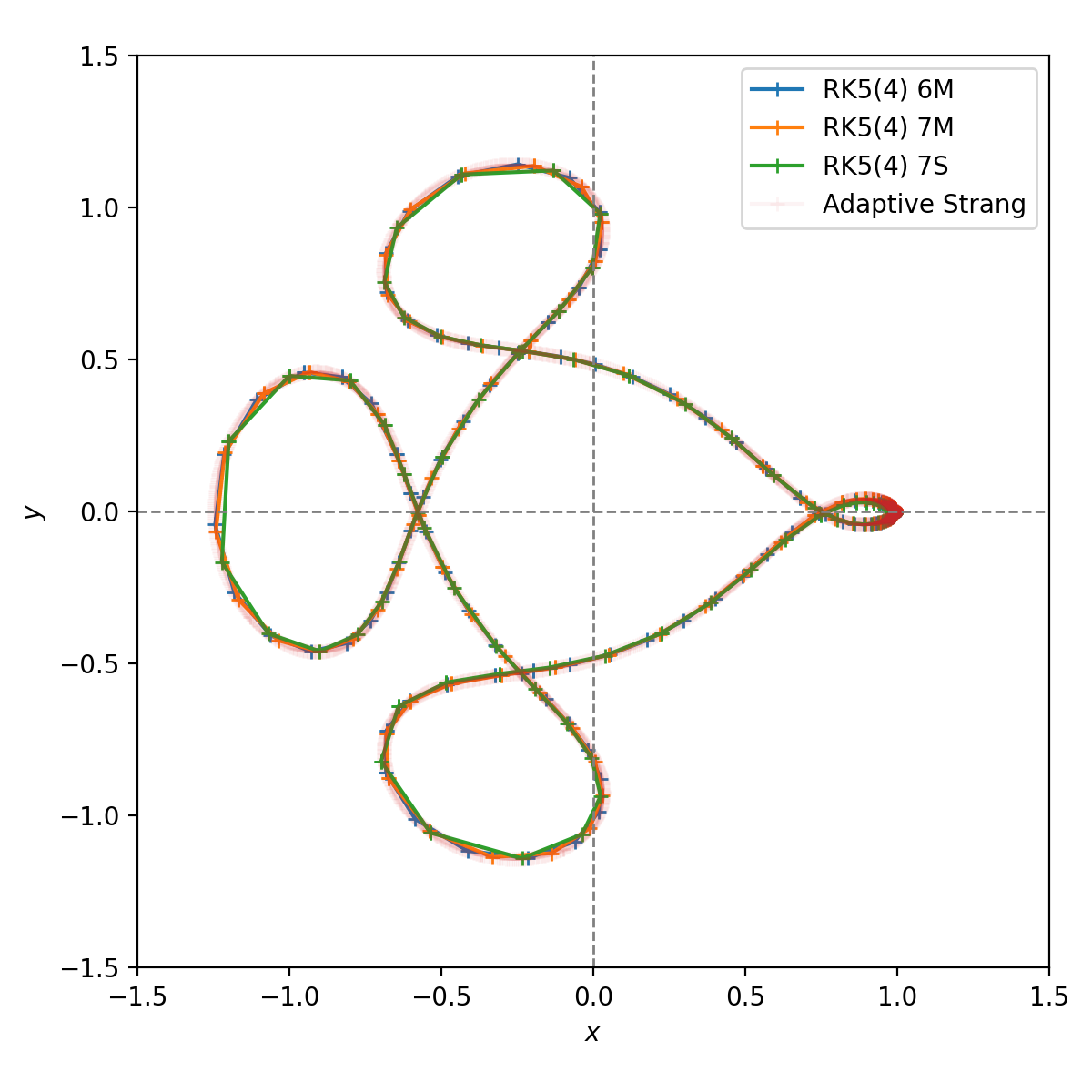
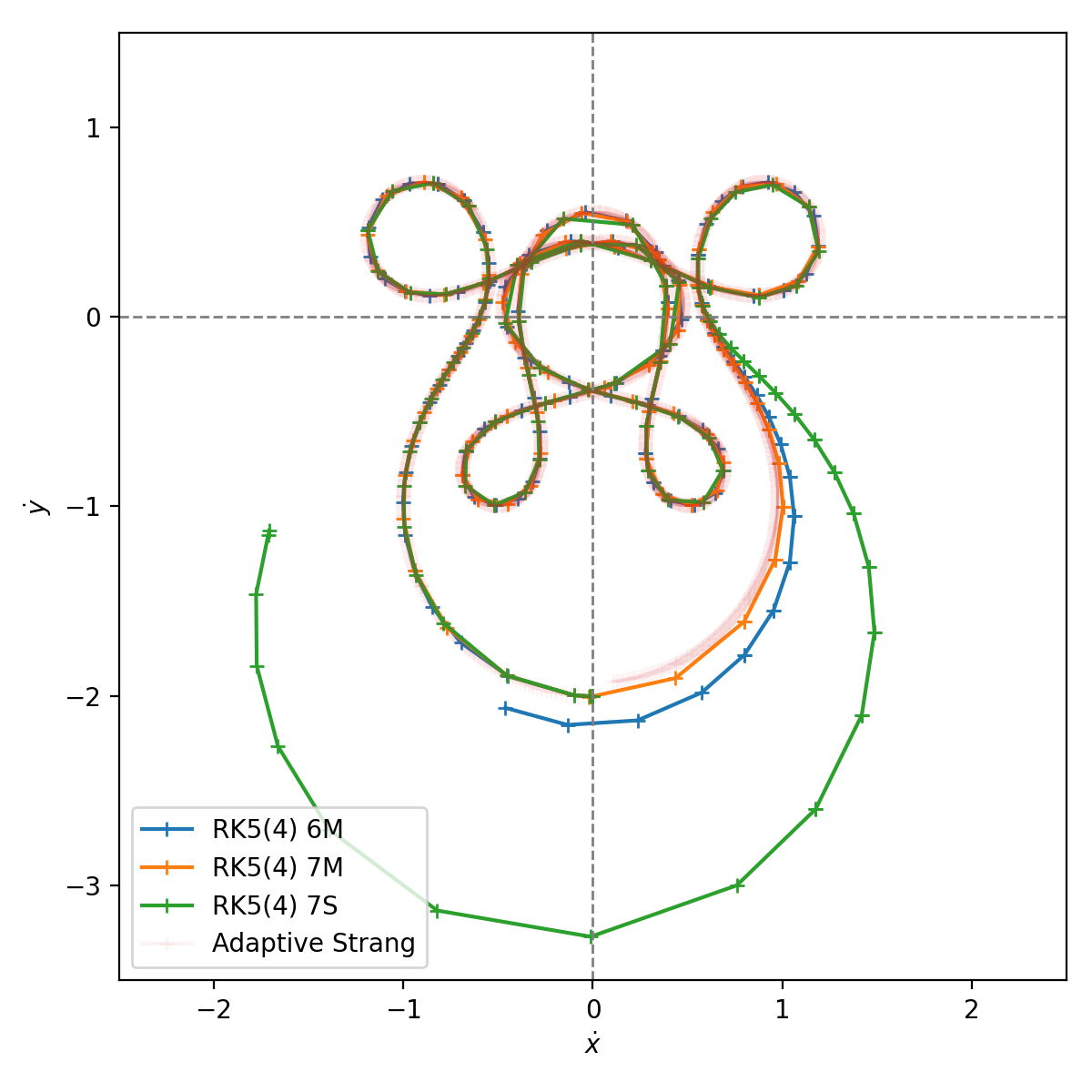
Time step history |
Error over time |
|---|---|
|
|
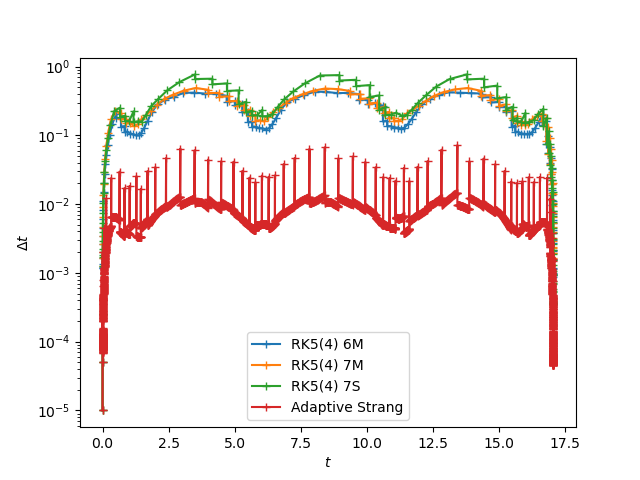
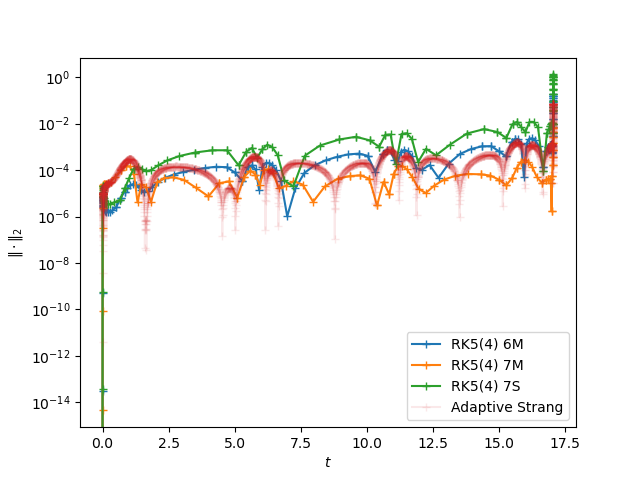
All example in arenstorf.cpp, and run
make arenstorf_visu
Brownian movement#
We write a simple Brownian movement
where \(X(t)\) and \(Y(t)\) are random variable (juste a std::rand at each iteration).
Some Brownian movement in 2D |
|---|
|
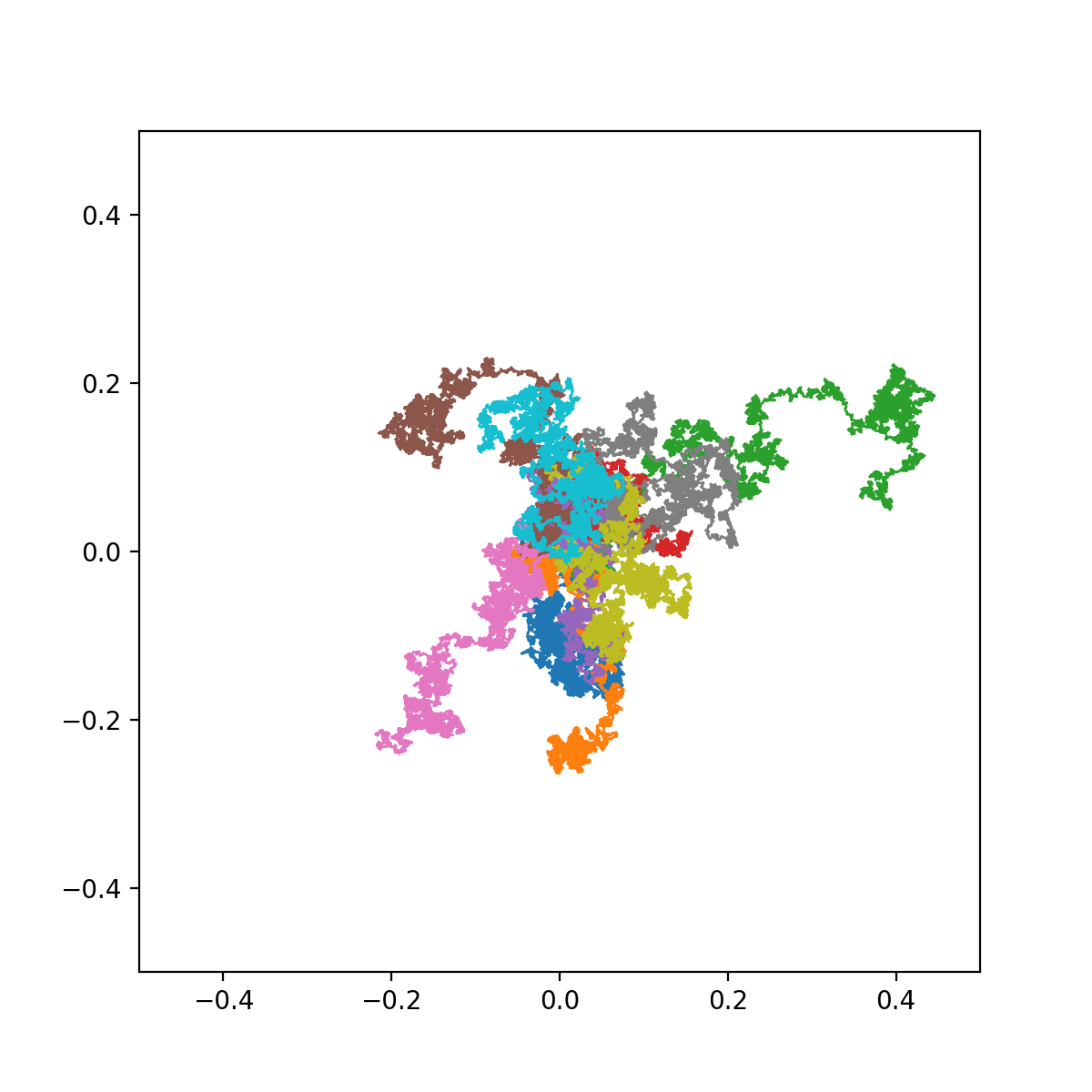
All example in brownian.cpp, and run
make brownian_visu
Brusselator equations#
The Brusselator is a model of periodic chemical reaction. We present the version ODE with two species
We solve this model with a hight order explicit Runge-Kutta method: RK(8, 6).
Brusselator concentration |
Brusselator concentration in phase space |
|---|---|
|
|
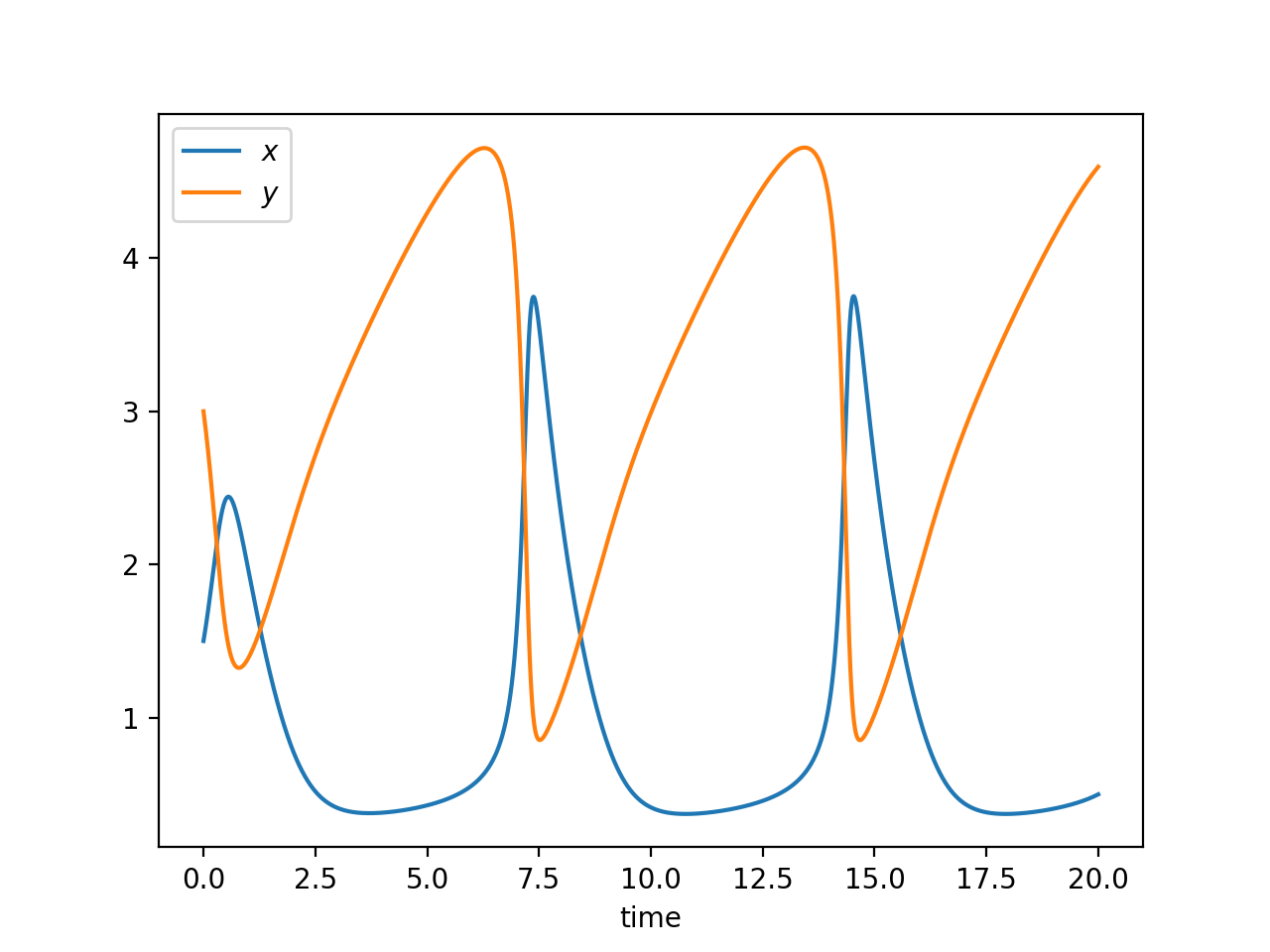
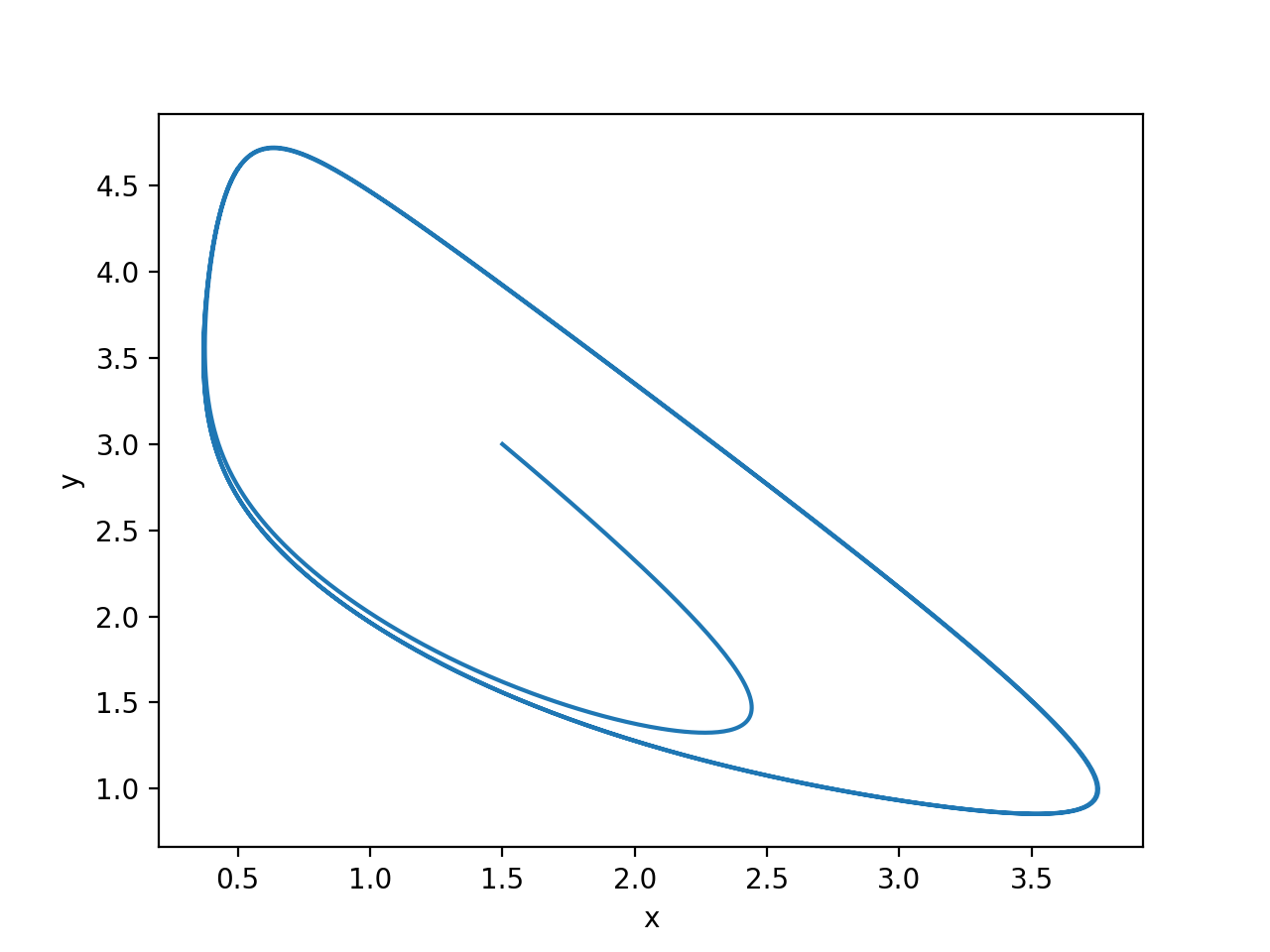
All example in brusselator.cpp, and run
make brusselator_visu
Brusselator equations with DIRK method#
The Brusselator is a model of periodic chemical reaction. We present the version ODE with two species
In this example we choose to solve the model with a diagonal-implicit Runge-Kutta method. The problem object has to be an ponio::implicit_problem and we need to compute the Jacobian matrix and proposes some linear algebra routines. For that we use Eigen library.
If state_t is floating point, a Eigen vector or a samurai field, ponio provides functions to solve implicit problems. In all cases, you can specify your own linear algebra object that contains a solver method (see lin_alg_2_2 structure), that takes a matrix \(A\) (same type as the returns type of jacobian gives to ponio::implicit_problem) and a vector \(b\) (same type as state_t) and return the solution of the linear problem
Brusselator concentration |
Brusselator concentration in phase space |
|---|---|
|
|
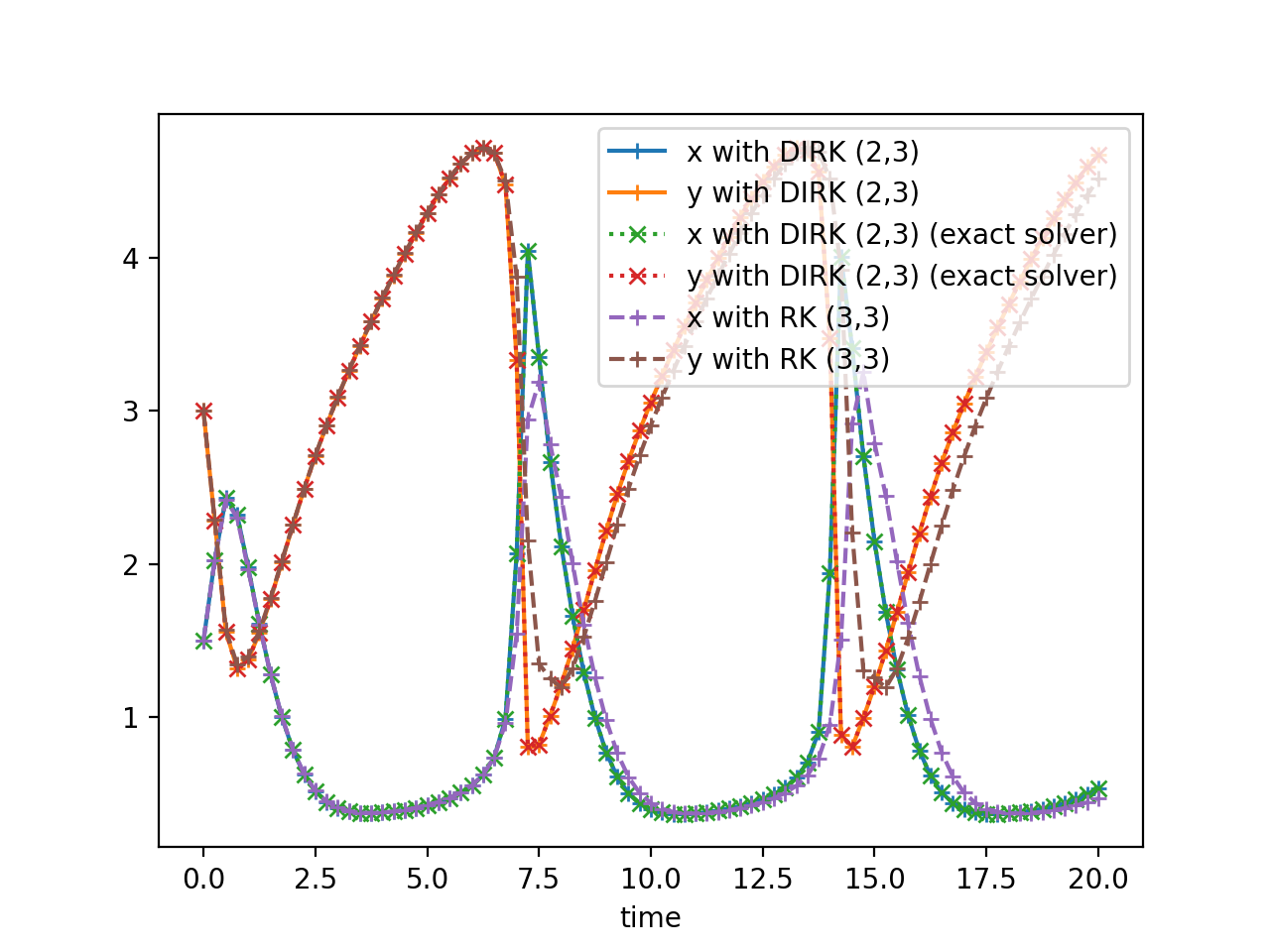
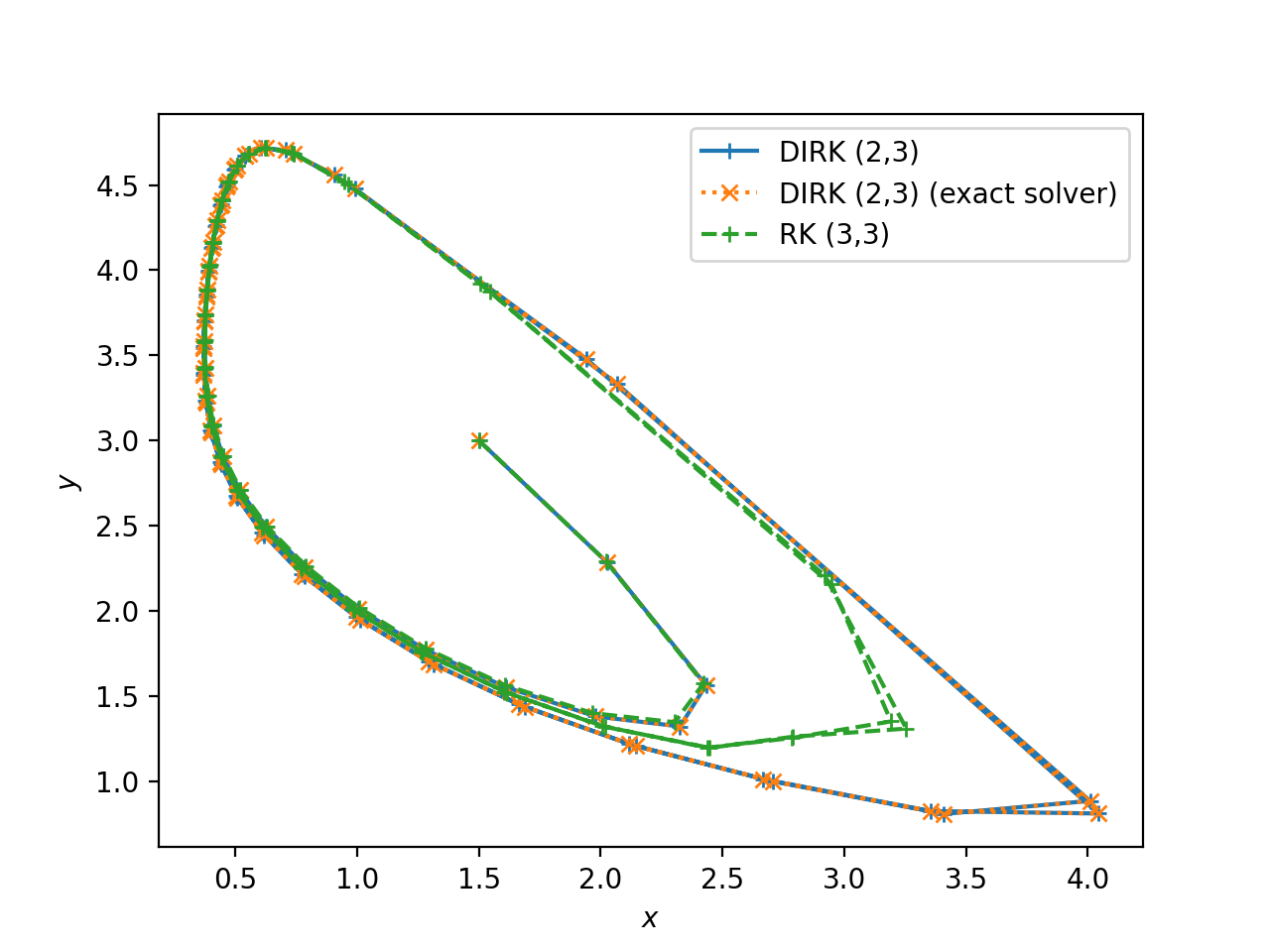
All example in brusselator_dirk.cpp, and run
make brusselator_dirk_visu
Curtiss-Hirschfelder equation#
A classical stiff problem is the Curtiss-Hirschfelder equation
with \(k>1\) and \(y(0) = y_0\). We choose \(k = 50\) and \(y_0 = 2\).
In this example we present how to control time loop with a ponio::solver_range. You can do it with an iterator on this range with :
auto sol_range = ponio::make_solver_range( ... );
and iterate over this range with a classical iterator with:
for ( auto it = sol_range.begin(); it < sol_range.end(); ++it )
{
  // ...
  // current time : it->time
  // current state : it->state
  // current time step : it->time_step
}
or with a range-based for loop:
for ( auto ui : sol_range )
{
  // ...
}
Only in the first case you can control time step before increment (with your adaptive time step heuristic) with modification of it->time_step data member.
Curtiss-Hirschfelder solution |
|---|
|
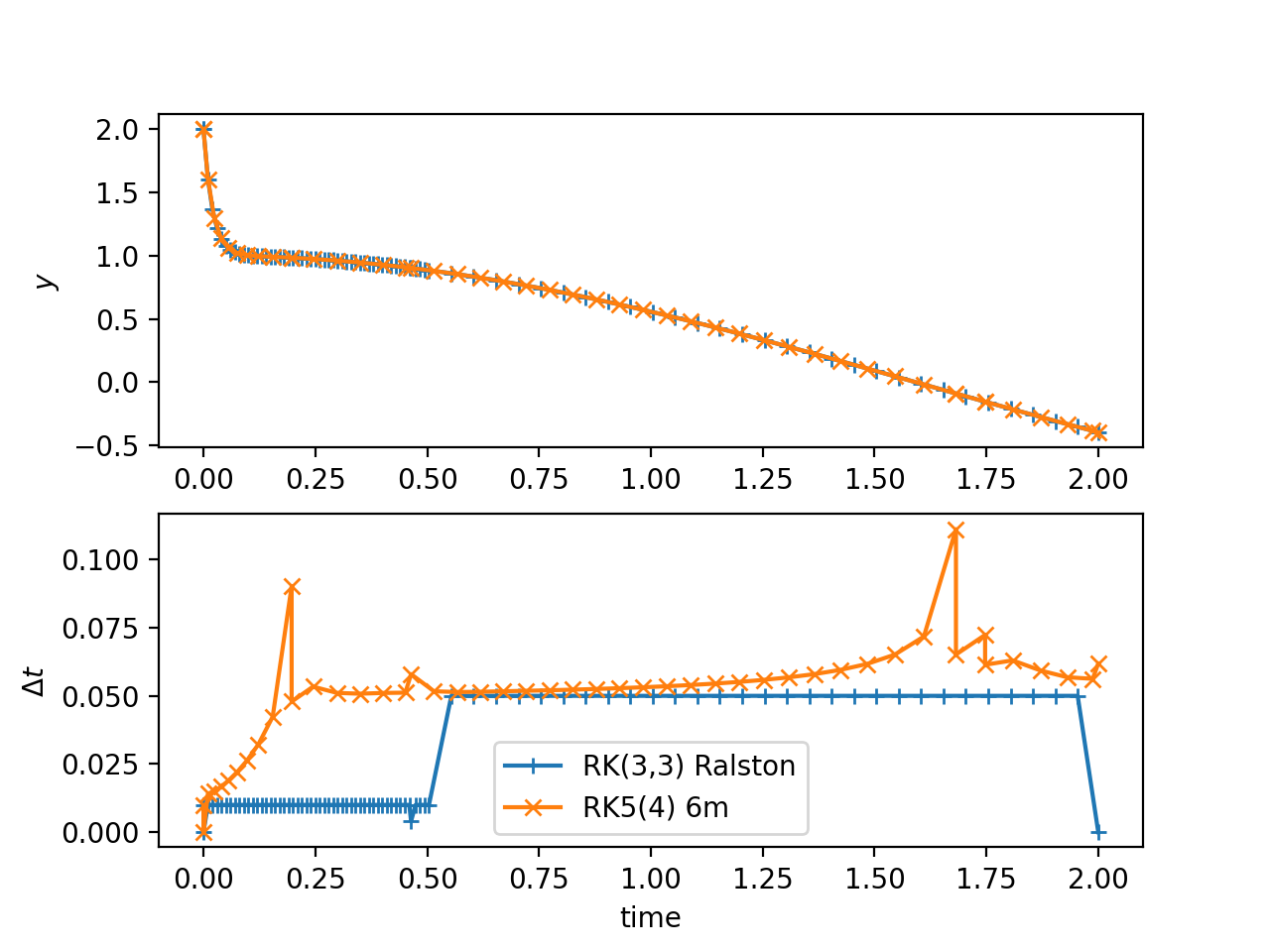
All example in curtiss_hirschfelder.cpp, and run
make curtiss_hirschfelder_visu
Curtiss-Hirschfelder equation with expRK method#
A classical stiff problem is the Curtiss-Hirschfelder equation
with \(k>1\) and \(y(0) = y_0\). We choose \(k = 50\) and \(y_0 = 2\).
In this example we solve the equation with Krogstad method (an exponential Runge-Kutta method), and LRK(4, 4) method (a Lawson method). In both methods, you need to define a ponio::lawson_problem with a linear and non-linear part. We choose the linear part \(-k\) and the non-linear part as \(N:t, y\mapsto k\cos(t)\). Exponential Runge-Kutta methods and Lawson methods are build to solve exactly the linear part when the non-linear part goes to 0.
Curtiss-Hirschfelder solution |
|---|
|
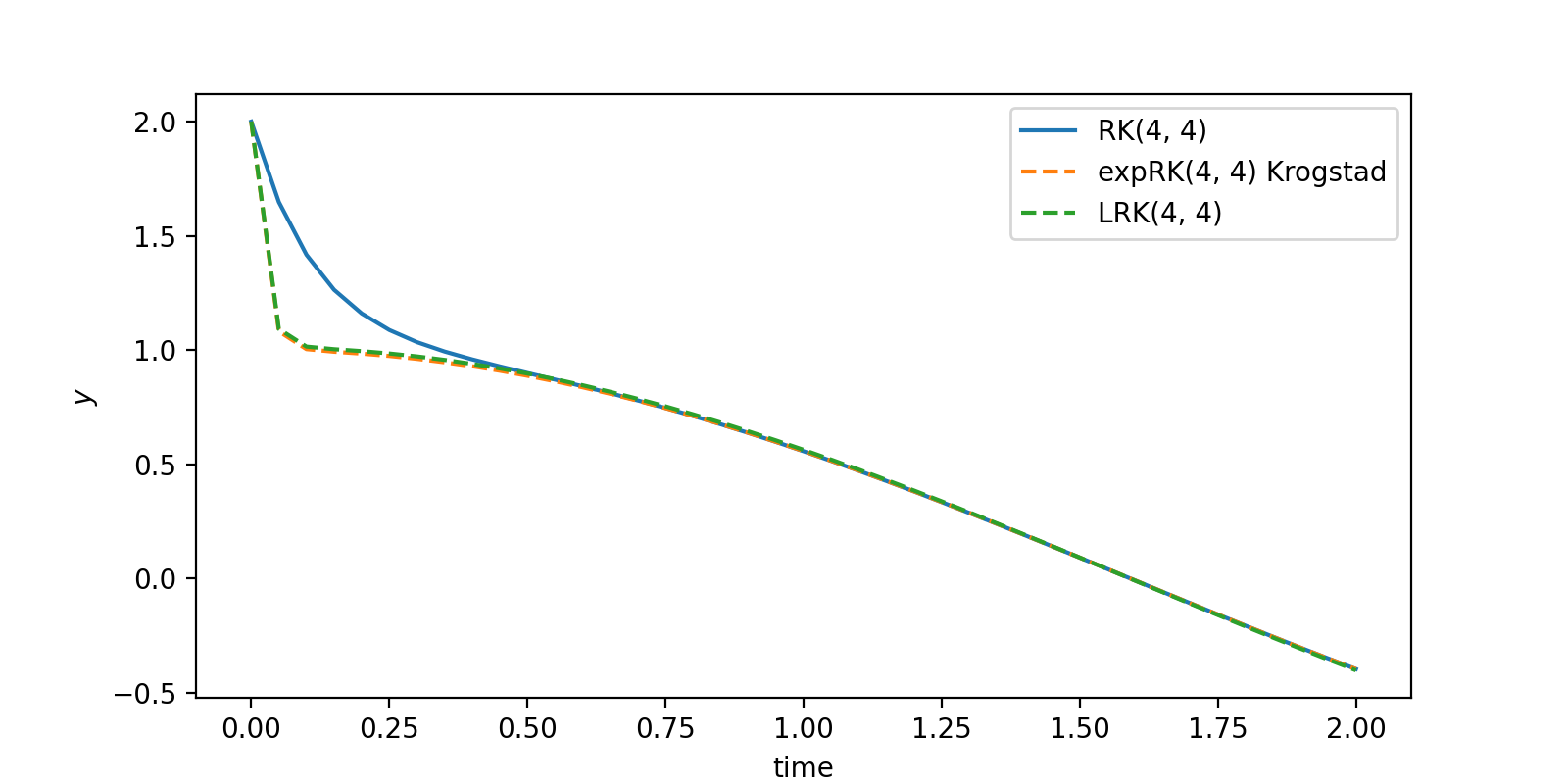
All example in curtiss_hirschfelder_exprk.cpp, and run
make curtiss_hirschfelder_exprk_visu
Exponential function#
In this example we solve the simplest differential equation:
with \(y(0) = 1\). After a lot of calculus we can find the exact solution \(y(t) = e^t\), or we can approximate it with RK NSSP (2, 1) method.
Exponential function |
|---|
|
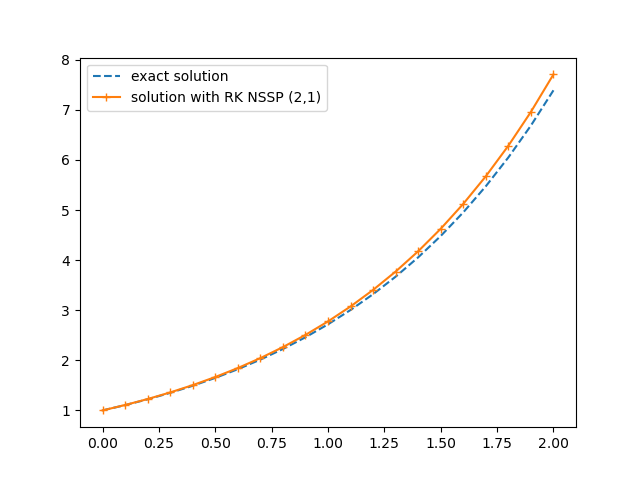
All example in exp.cpp, and run
make exp_visu
Exponential function with exact solver#
In this example we solve the simplest differential equation:
with \(y(0) = 1\) and \(\lambda = 0.3\). In this example we solve this equation with:
a Strang splitting method with \(f_1:(t,y)\mapsto \lambda y\) (which is solved exactly), and \(f_2:(t,y)\mapsto (1-\lambda)y\) (which is solved with a RK(2,2) Raslton).
an exact solver \(\phi:(f,t,u,\Delta t)\mapsto e^{\Delta t}u\).
a RK(2,2) Ralston method.
Exponential function |
|---|
|
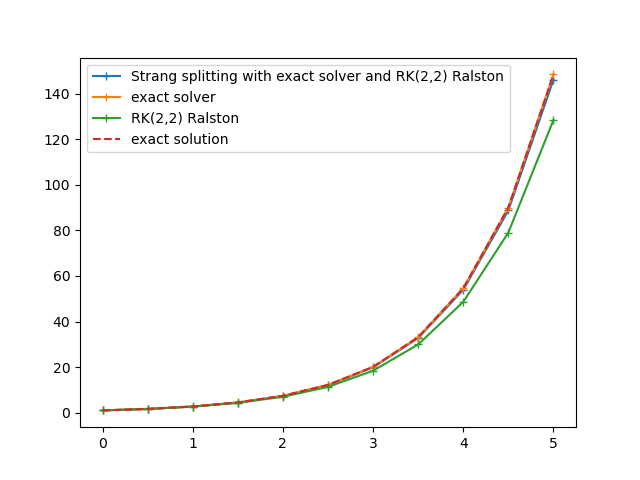
All example in exp_splitting.cpp, and run
make exp_splitting_visu
Heat model#
In this example we propose to solve a PDE, the heat equation in 1D
with the initial condition gives by the fundamental solution of head equation at time \(t=0.001\) given by:
In ponio, the state_t should propose arithmetic operations as addition and multiplication by a scalar (of type value_t). For the sake of simplicity, we use in the example a std::valarray<double>.
The heat equation is quite complicated to solve with an explicit Runge-Kutta method but we do it with a extended stability method with the Runge-Kutta Chebyshev of order 2. In ponio you could choose the number of stages of this method : ponio::runge_kutta::explicit_rkc2<15>() (for 15 stages).
Solution of heat equation |
|---|
|
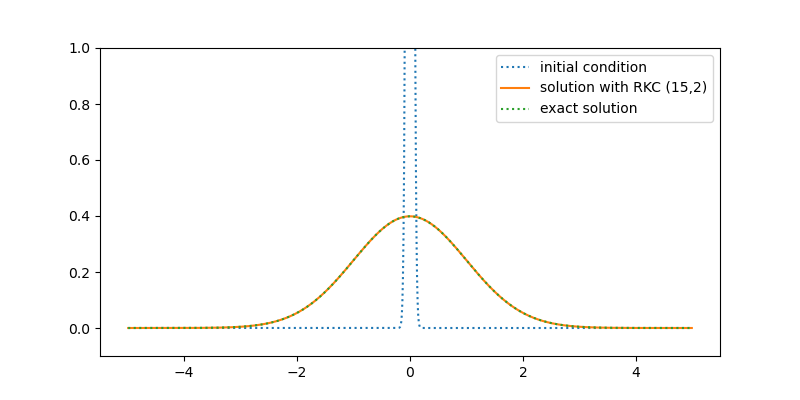
All example in heat.cpp, and run
make heat_visu
ROCK method#
In this example we propose to solve a PDE, the heat equation in 1D
with the initial condition gives by the fundamental solution of head equation at time \(t=0.001\) given by:
In ponio, the state_t should propose arithmetic operations as addition and multiplication by a scalar (of type value_t). For the sake of simplicity, we use in the example a std::valarray<double>.
An optimization of RKC2 is the ROCK2 method from Abdulle, A., Medovikov, A. Second order Chebyshev methods based on orthogonal polynomials. Numer. Math (2001), and its extension to order 4, ROCK4 method presented in Abdulle, A. Fourth Order Chebyshev Methods with Recurrence Relation. SIAM Journal on Scientific Computing (2002).
Solution of heat equation |
Mesure of order of ROCK2 and ROCK4 |
|---|---|
|
|
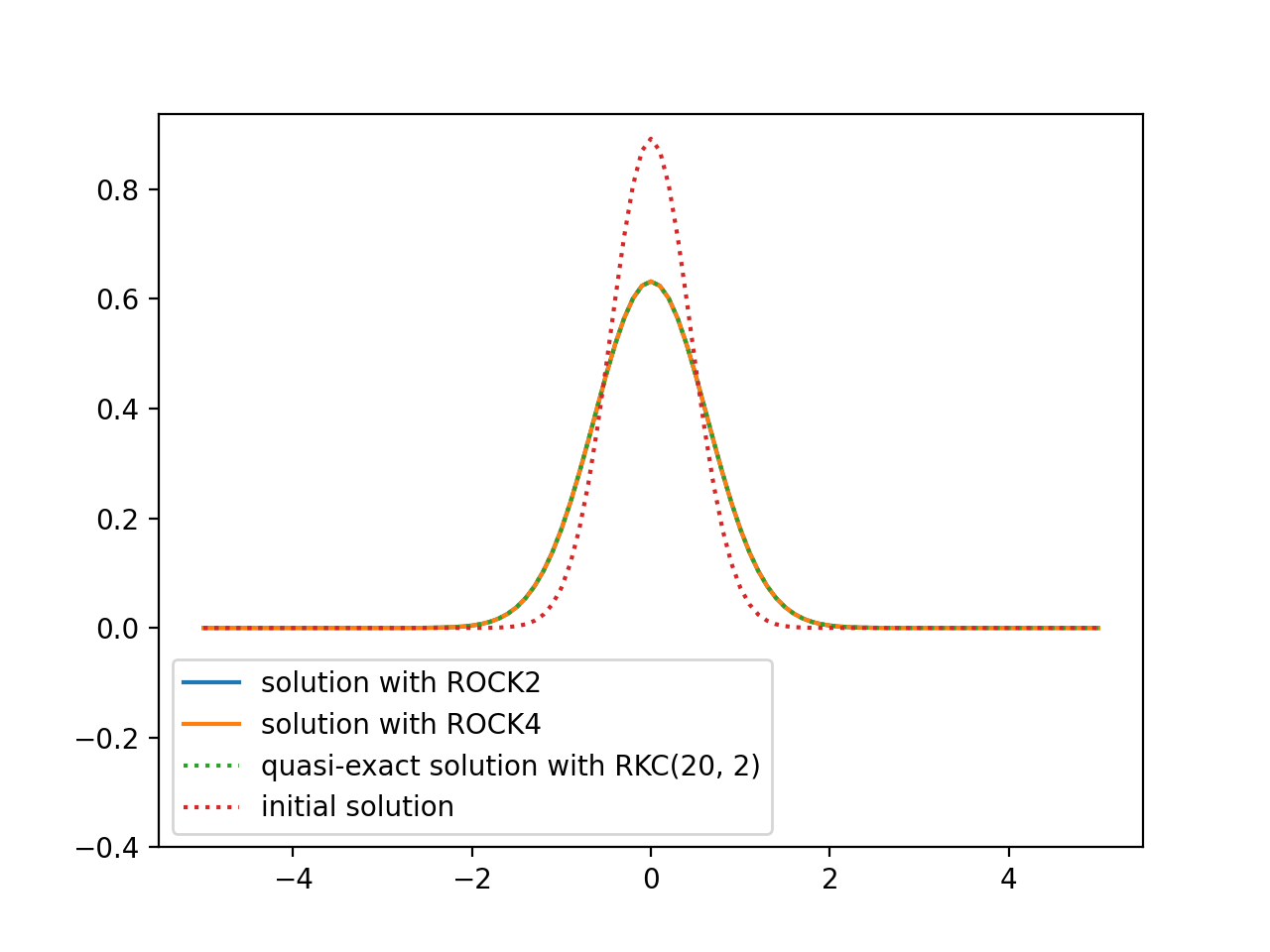
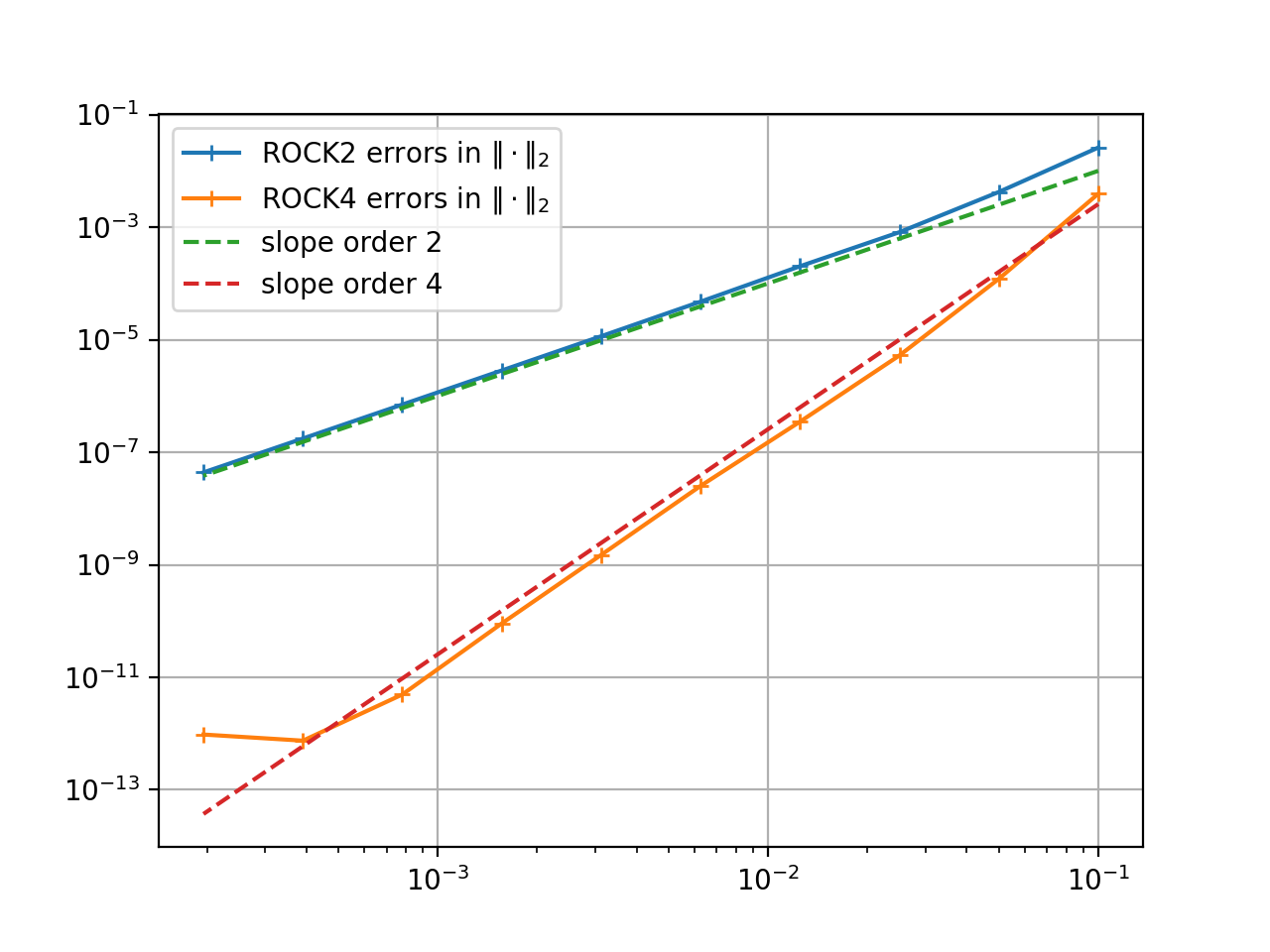
All example in heat_rock.cpp, and run
make heat_rock_visu
Samurai is hot#
This example needs to activate
-DBUILD_SAMURAI_DEMOS=ON
In this example we propose to solve a PDE, the heat equation in 1D
with the initial condition gives by the fundamental solution of head equation at time \(t=0.001\) given by:
In this example we coupling the mesh refinement library samurai with ponio.
Solution of heat equation with levels of adaptive mesh |
|---|
|
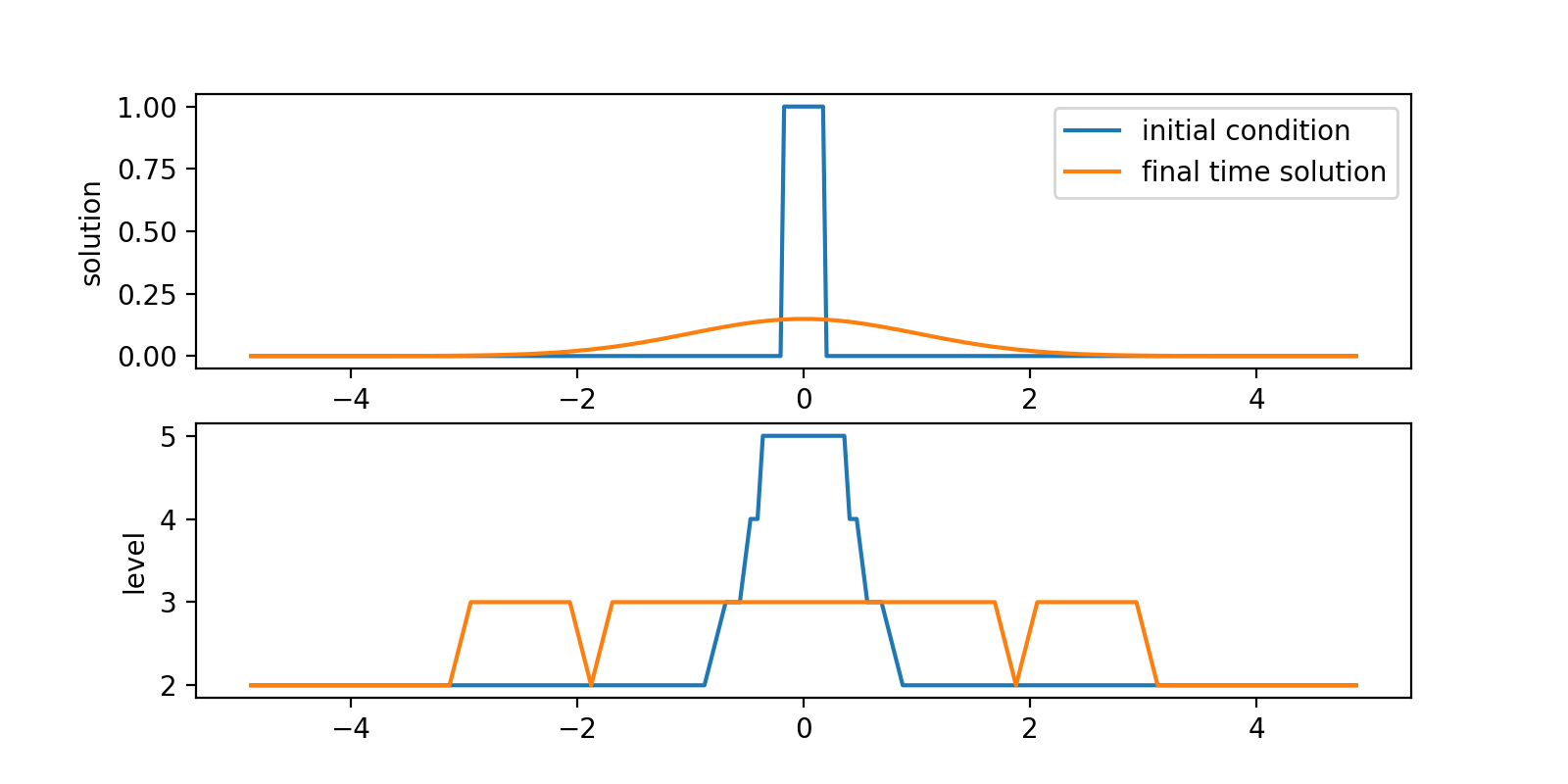
All example in heat_samurai.cpp, and run
make heat_samurai_visu
Lorenz equations#
The classical chaotic system example of Lorenz equations
Solution in 3D |
Solution by composant |
|---|---|
|
|
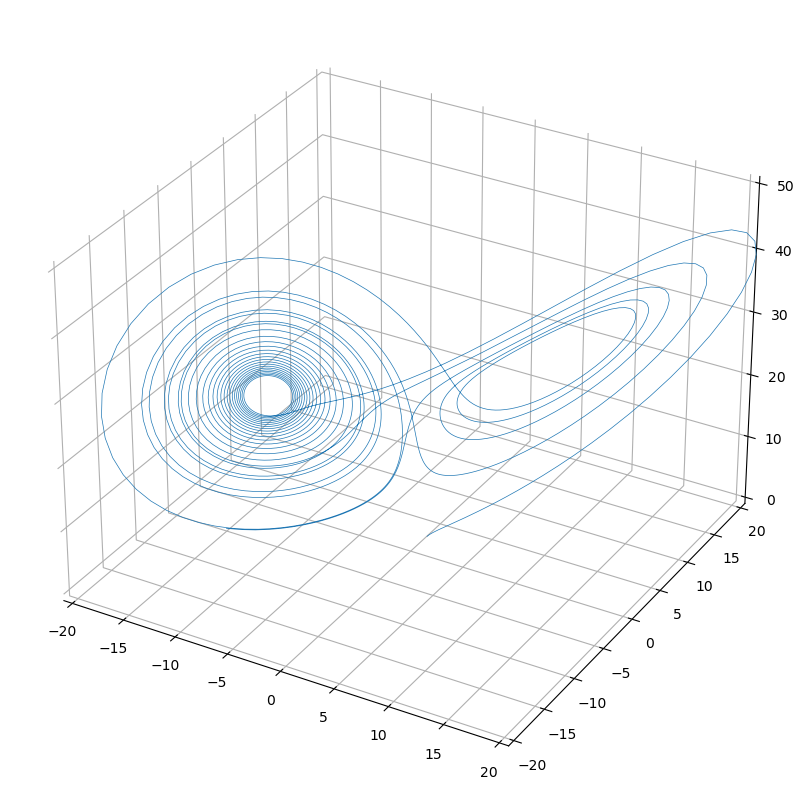
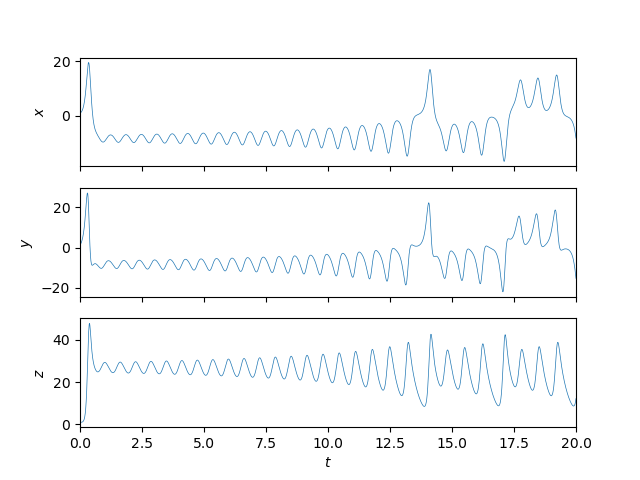
All example in lorenz.cpp, and run
make lorenz_visu
Lorenz equations with multiple methods#
The classical chaotic system example of Lorenz equations
Solution in 3D |
Solution by composant |
|---|---|
|
|
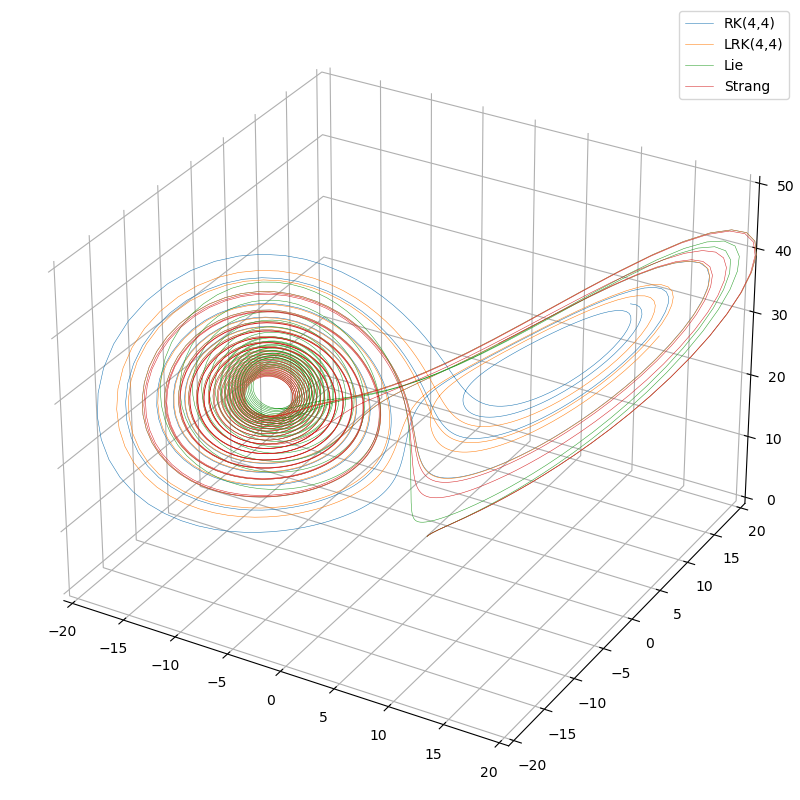
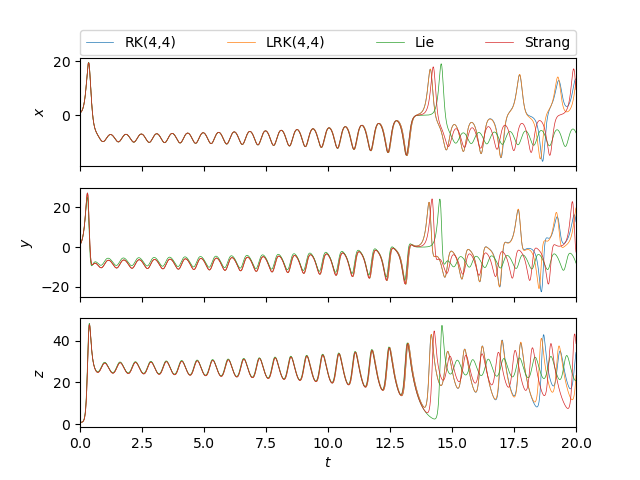
All example in lorenz_tuto.cpp, and run
make lorenz_tuto_visu
Lorenz equations with all methods#
The classical chaotic system example of Lorenz equations
Solution in 3D |
|---|
|

All example in lorenz_all.cpp, and run
make lorenz_all_visu
Lotka-Volterra model#
The classical predator–prey model of Lotka-Volterra:
with parameters \(\alpha=\frac{2}{3}\), \(\beta=\frac{4}{3}\), \(\gamma = \delta = 1\), and with the initial condition \((x, y) = (x_0, x_0)\), with different values of \(x_0\).
Prey predator history |
Solution in phase space |
|---|---|
|
|
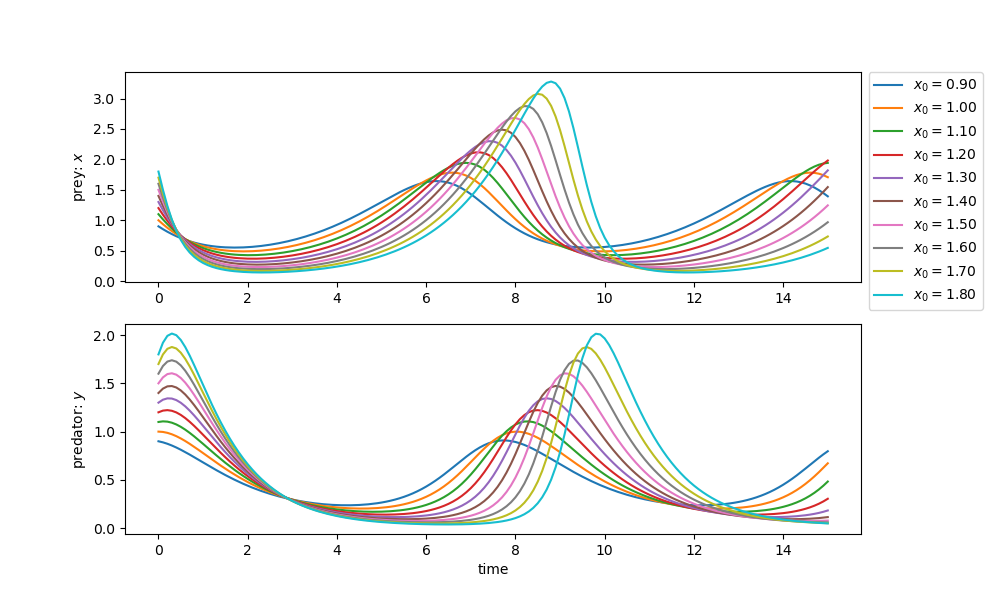
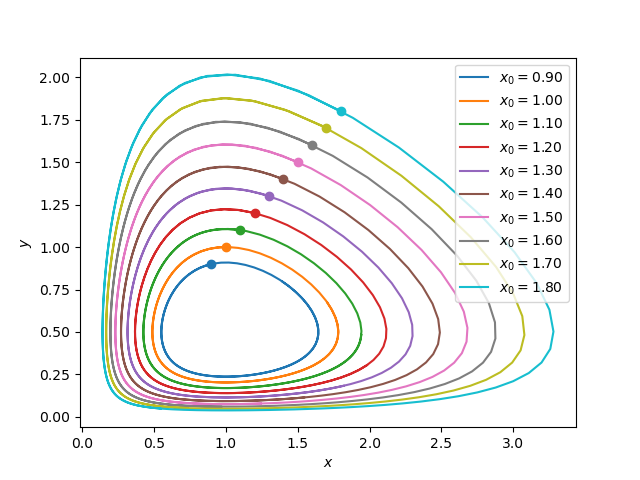
All example in lotka_volterra.cpp, and run
make lotka_volterra_visu
Nagumo equation#
The Nagumo equation is a propagation of a traveling wave
with parameter \(k=1\), \(d=1\), with the initial solution given by exact solution to time \(t=0\):
where
Solution with RKC(20, 2) |
Absolute error |
|---|---|
|
|
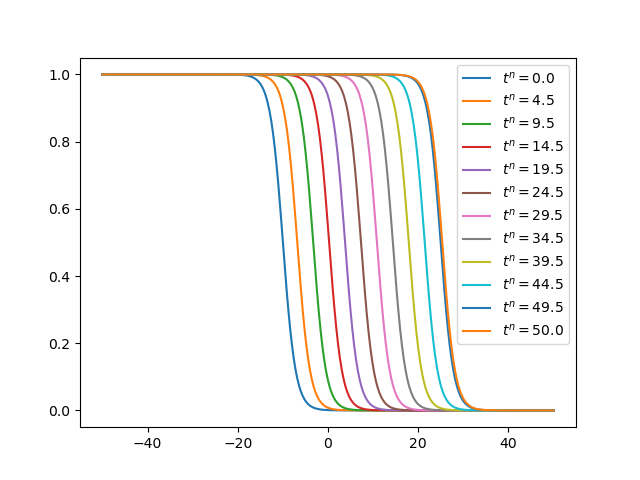
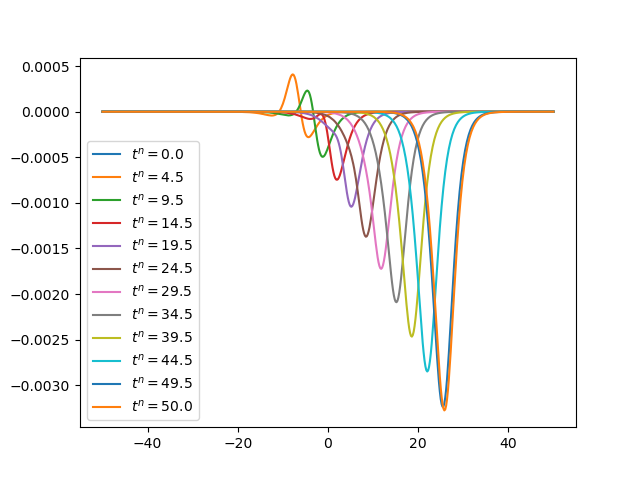
All example in nagumo.cpp, and run
make nagumo_visu
Pendulum equation#
The second order differential equation for the angle \(\theta\) of a pendulum acted on by gravity with friction can be written:
where \(b\) and \(c\) are positive constants, we take \(b=0.25\), \(c=5.0\). As Arenstorf orbit, we have to rewrite problem as \(\dot{u} = f(t, u)\) :
Pendulum equation (solved with RK (4,4)) |
|---|
|
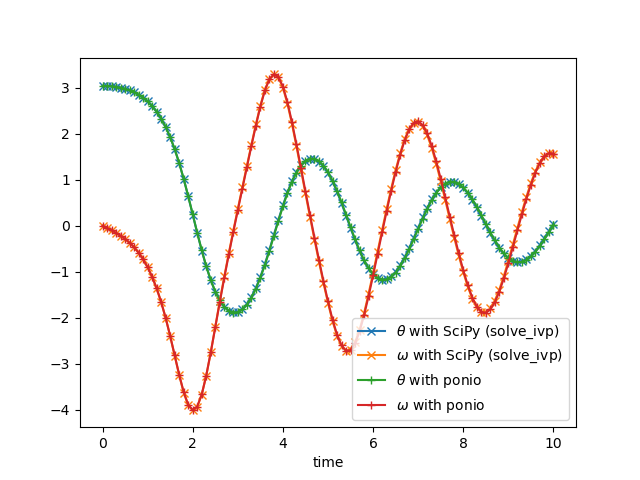
All example in pendulum.cpp, and run
make pendulum_visu
Belousov Zhabotinsky#
This example needs to activate
-DBUILD_SAMURAI_DEMOS=ON
The Belousov Zhabotinsky reaction is a chemical periodic reaction, in this example we look at a 1D reduction model given by
with parameter
and diffusion coefficients
In this example we coupling the mesh refinement library samurai with ponio, and the system is solved by PIROCK method.
Belousov Zhabotinsky system solved by PIROCK method |
|---|
|
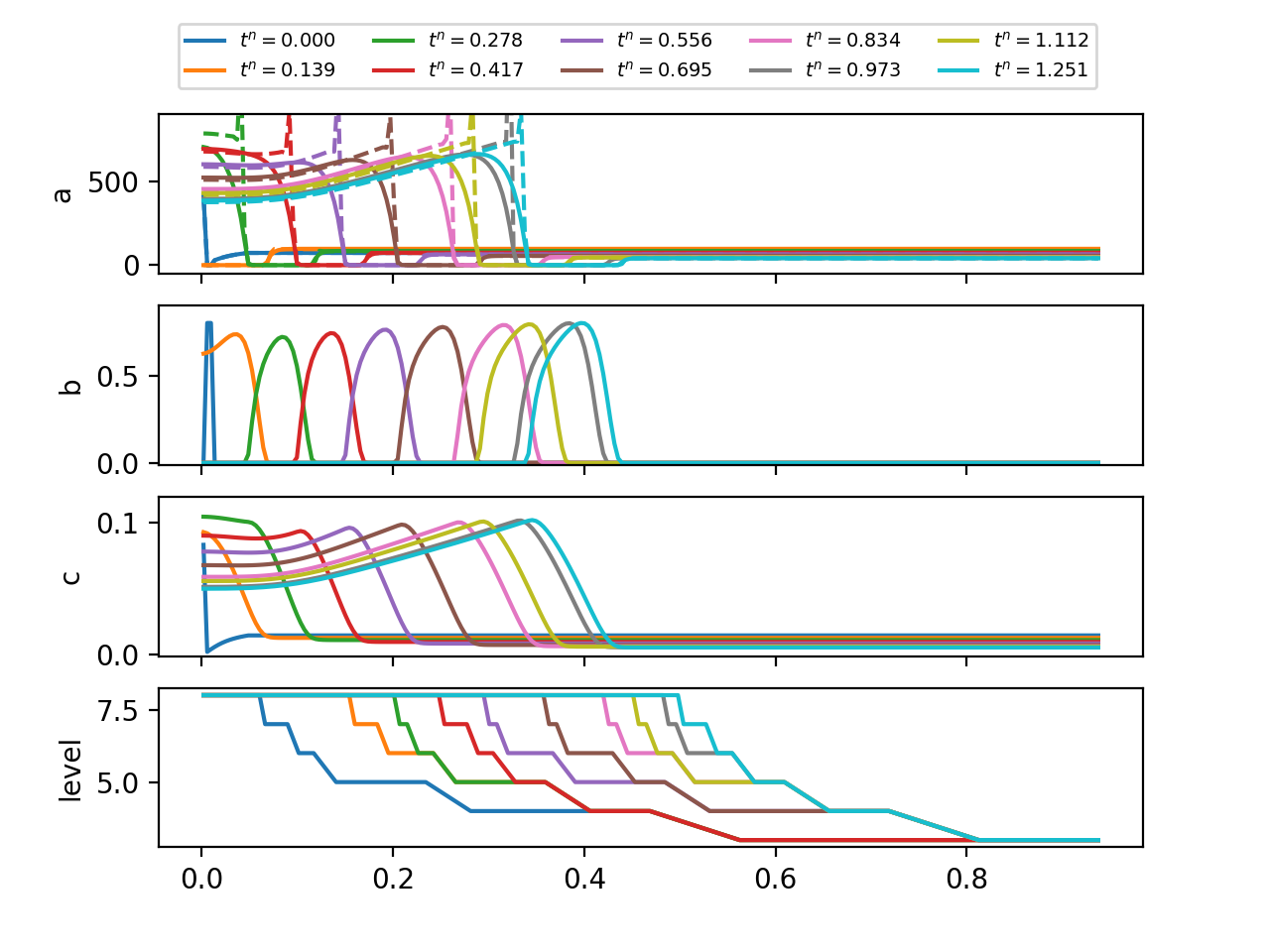
All example in belousov_zhabotinsky_pirock.cpp, and run
make belousov_zhabotinsky_pirock_visu
Belousov Zhabotinsky in 2D#
This example needs to activate
-DBUILD_SAMURAI_DEMOS=ON
The Belousov Zhabotinsky reaction is a chemical periodic reaction, in this example we look at a 1D reduction model given by
with parameter
and diffusion coefficients
In this example we coupling the mesh refinement library samurai with ponio, and the system is solved by PIROCK method.
Solution \(b\) and \(c\) |
Levels of adapted mesh on solution |
|---|---|
|
|
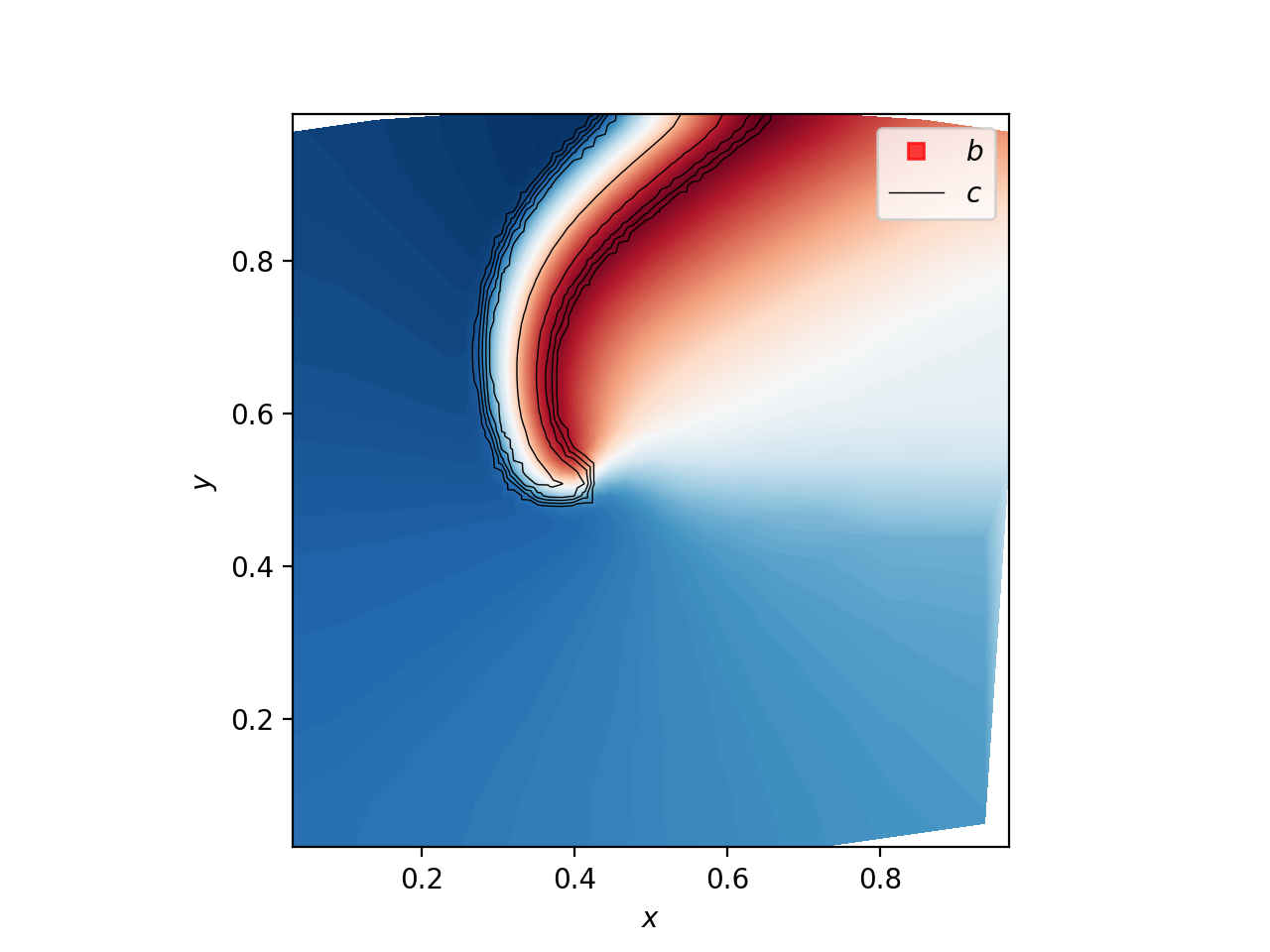
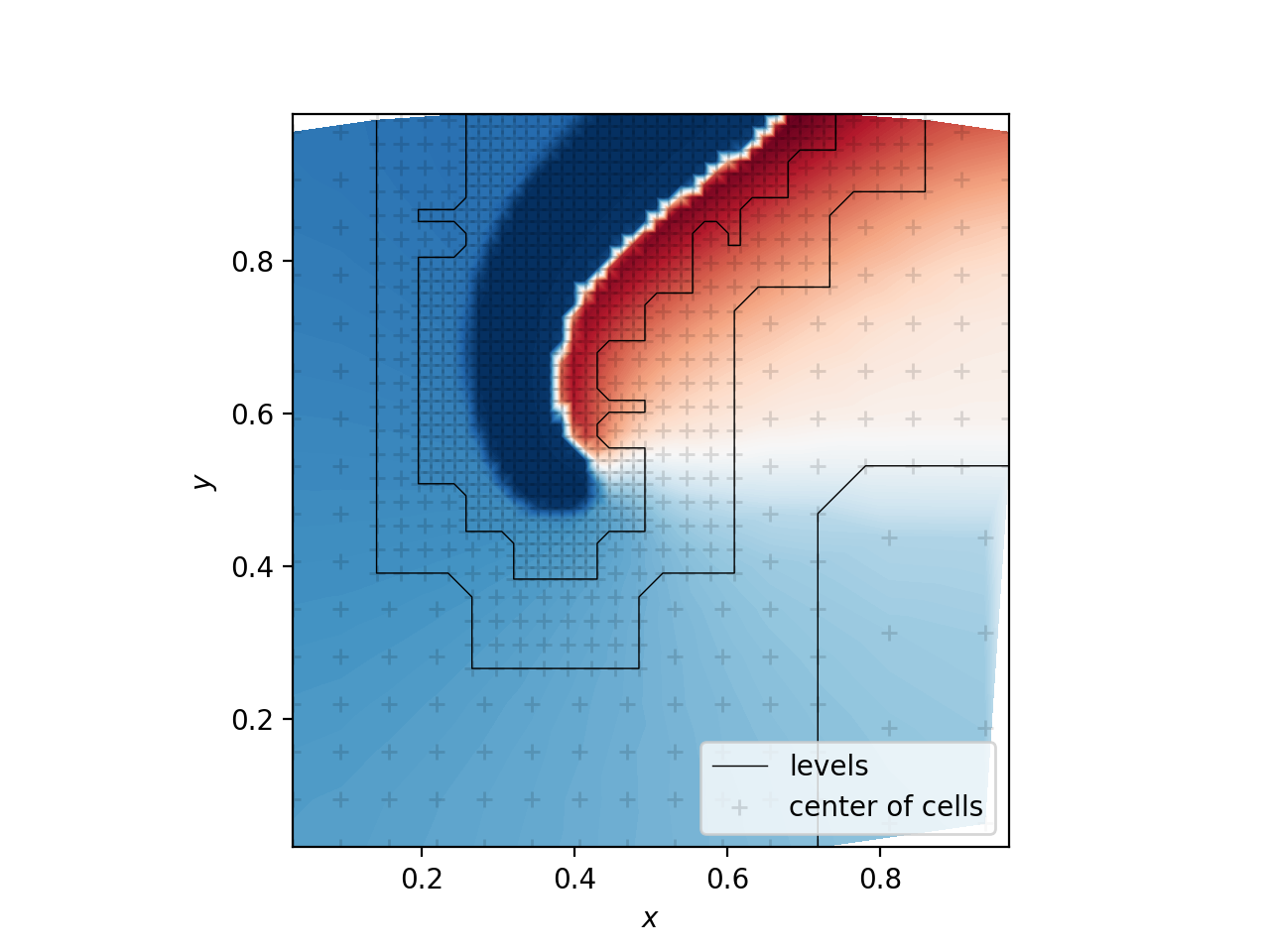
All example in bz_2d_pirock.cpp, and run
make bz_2d_pirock_visu