Lotka-Volterra system with some exponential Runge-Kutta method#
In this example we present how to write a program to solve the Lotka-Volterra equations with Ponio.
The system is definied as:
\[\begin{split}\begin{aligned}
\frac{\mathrm{d}x}{\mathrm{d}t} &= \alpha x - \beta xy \\
\frac{\mathrm{d}y}{\mathrm{d}t} &= \delta xy - \gamma y \\
\end{aligned}\end{split}\]
where:
\(x\) is the number of prey
\(y\) is the number of predators
\(t\) represents time
\(\alpha\), \(\beta\), \(\gamma\) and \(\delta\) are postive real parameters describing the interaction of the two species.
We would like to compute the invariant \(V\) definied by:
\[V = \delta x - \gamma \ln(x) + \beta y - \alpha \ln(y)\]
We will use the same decomposition into linear and non-linear as the Lawson presentation:
\[\dot{u} = Lu + N(t,u)\]
with \(u=(x,y)\) and:
\[\begin{split}L = \begin{pmatrix}\alpha & 0 \\ 0 & -\gamma\end{pmatrix}
\qquad
N:(t,u)\mapsto \begin{pmatrix}-\beta u_1u_2 \\ \delta u_1u_2 \end{pmatrix}\end{split}\]
Since the linear part is diagonal, we can use a std::valarray to
reprensent it.
%system mkdir -p lotka_volterra_expRK_demo
[]
%%writefile lotka_volterra_expRK_demo/main.cpp

#include <iostream>
#include <valarray>

#include "ponio/solver.hpp"
#include "ponio/observer.hpp"
#include "ponio/problem.hpp"
#include "ponio/runge_kutta.hpp"

int main()
{
    using state_t = std::valarray<double>;
    using namespace ponio::observer;

    double alpha = 2./3., beta=4./3., gamma=1., delta=1.;

    state_t L = { alpha, -gamma };
    auto N = [=]( double t, state_t const& u, state_t& du ) {
        double x=u[0], y=u[1];
        du[0] = -beta*x*y;
        du[1] = delta*x*y;
    };
    auto pb  = ponio::make_lawson_problem(L,N);

    double dt = 0.1;
    double tf = 100;
    state_t u_ini = {1.8,1.8};

    ponio::solve(pb, ponio::runge_kutta::exprk22_t<double, state_t>()            , u_ini, {0.,tf}, dt, "lotka_volterra_expRK_demo/exprk_exprk22.dat"_fobs);
    ponio::solve(pb, ponio::runge_kutta::krogstad_t<double, state_t>()           , u_ini, {0.,tf}, dt, "lotka_volterra_expRK_demo/exprk_k.dat"_fobs);
    ponio::solve(pb, ponio::runge_kutta::cox_matthews_t<double, state_t>()       , u_ini, {0.,tf}, dt, "lotka_volterra_expRK_demo/exprk_cm.dat"_fobs);
    ponio::solve(pb, ponio::runge_kutta::strehmel_weiner_t<double, state_t>()    , u_ini, {0.,tf}, dt, "lotka_volterra_expRK_demo/exprk_sw.dat"_fobs);
    ponio::solve(pb, ponio::runge_kutta::hochbruck_ostermann_t<double, state_t>(), u_ini, {0.,tf}, dt, "lotka_volterra_expRK_demo/exprk_ho.dat"_fobs);
    ponio::solve(pb, ponio::runge_kutta::etd2cf3_t<double, state_t>()            , u_ini, {0.,tf}, dt, "lotka_volterra_expRK_demo/exprk_etd2cf3.dat"_fobs);
    ponio::solve(pb, ponio::runge_kutta::etd3rk_t<double, state_t>()             , u_ini, {0.,tf}, dt, "lotka_volterra_expRK_demo/exprk_etd3rk.dat"_fobs);

    return 0;
}
Writing lotka_volterra_expRK_demo/main.cpp
%system $CXX -std=c++20 -I ../include lotka_volterra_expRK_demo/main.cpp -o lotka_volterra_expRK_demo/main
[]
%system ./lotka_volterra_expRK_demo/main
[]
import numpy as np
import matplotlib.pyplot as plt

methods = [
    ("exprk22", "expRK(2,2)"),
    ("k", "Krogstad"),
    ("cm", "Cox-Matthews"),
    ("sw", "Strehmel Weiner"),
    ("ho", "Hochbruck-Ostermann"),
    ("etd2cf3", "ETD2CF3"),
    ("etd3rk", "ETD3RK")
]


for tag, name in methods:
    data = np.loadtxt(f"lotka_volterra_expRK_demo/exprk_{tag}.dat")
    x_e = data[:,1]
    y_e = data[:,2]
    plt.plot(x_e[:int(len(x_e)/10)], y_e[:int(len(x_e)/10)], "-", label=name)
    del data

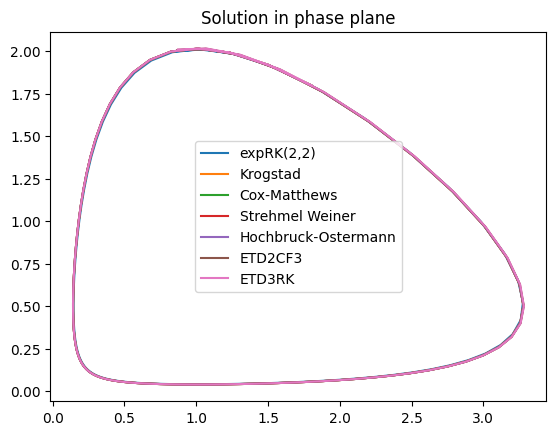
plt.title("Solution in phase plane")
plt.legend()
plt.show()
def V(x,y, alpha=2./3., beta=4./3., gamma=1., delta=1.):
    return delta*x - np.log(x) + beta*y - alpha*np.log(y)
for i,(tag, name) in enumerate(methods):
    data = np.loadtxt(f"lotka_volterra_expRK_demo/exprk_{tag}.dat")
    t_e = data[:,0]
    x_e = data[:,1]
    y_e = data[:,2]
    plt.plot(t_e, V(x_e, y_e), "-", label=name)
    del data
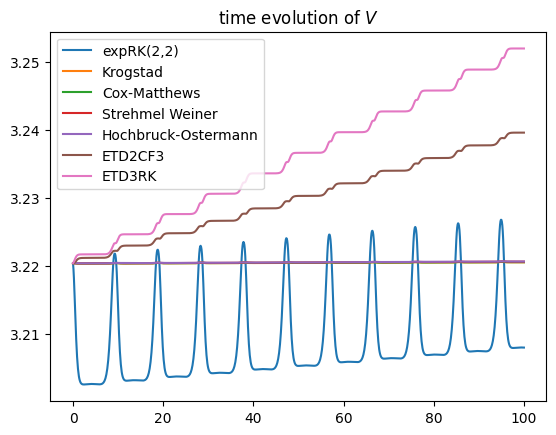
plt.title("time evolution of $V$")
plt.legend()
plt.show()
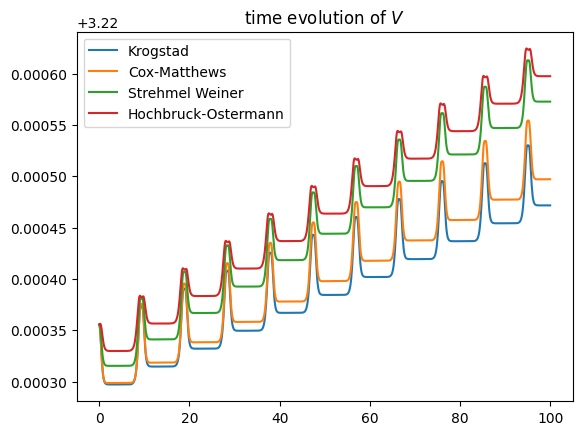
The same graph fro only high order methods
methods = [
    ("k", "Krogstad"),
    ("cm", "Cox-Matthews"),
    ("sw", "Strehmel Weiner"),
    ("ho", "Hochbruck-Ostermann")
]
for i,(tag, name) in enumerate(methods):
    data = np.loadtxt(f"lotka_volterra_expRK_demo/exprk_{tag}.dat")
    t_e = data[:,0]
    x_e = data[:,1]
    y_e = data[:,2]
    plt.plot(t_e, V(x_e, y_e), "-", label=name)
    del data
plt.title("time evolution of $V$")
plt.legend()
plt.show()