Lotka-Volterra system with a splitting method of Lie or Strang#
In this example we reuse previous definition in Lotka-Voleterra resolution with Runge-Kutta method which is the first tutorial. In this notebook we solve the same example.
The system is definied as:
where:
\(x\) is the number of prey
\(y\) is the number of predators
\(t\) represents time
\(\alpha\), \(\beta\), \(\gamma\) and \(\delta\) are postive real parameters describing the interaction of the two species.
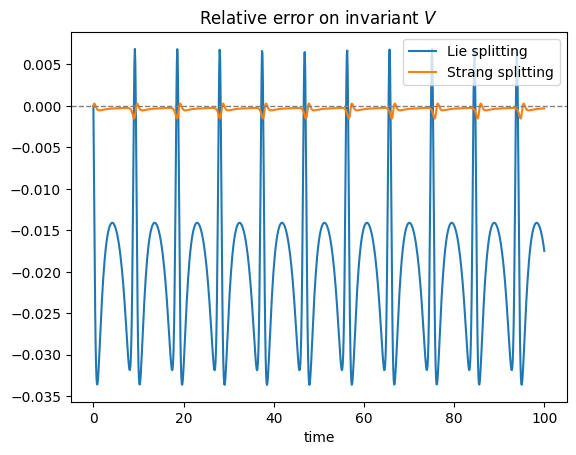
We would like to compute the invariant \(V\) definied by:
Lie or Strang splitting method#
An other class of time integrator in Ponio is splitting methods. To use it you need to define each subproblem. In Lotka-Volterra we chose to define this subproblems:
The Lie splitting is defined by
where \(\varphi^{[i]}_{\Delta t}\) is a solution after time \(\Delta t\) on the problem \(\varphi^{[i]}\).
The Strang splitting method is defined by
First we need to define two functions (or objects function):
auto phi1 = [=]( double t, state_t const& u ) -> state_t {
    double x = u[0], y = u[1];
    return { alpha*x - beta*x*y , 0. };
};
auto phi2 = [=]( double t, state_t const& u ) -> state_t {
    double x = u[0], y = u[1];
    return { 0. , delta*x*y - gamma*y };
};
Now define a ponio::problem with ponio::make_problem
auto pb = ponio::make_problem( phi1, phi2 );
To solve it with a Lie or Strang splitting method, we should define a tuple of pairs of methods and time step to say how to solve each sub-problem:
auto lie = ponio::splitting::make_lie_tuple(
        std::make_pair(ponio::runge_kutta::rk_44(),0.05),
        std::make_pair(ponio::runge_kutta::rk_33(),0.05)
    );

ponio::solve(pb, lie, u_ini, {0.,tf}, dt, "lotka_volterra_splitting_demo/lie.dat"_fobs);
For Strang splitting method, we define a ponio::strang_tuple in the
same way
auto strang = ponio::splitting::make_strang_tuple(
        std::make_pair(ponio::runge_kutta::rk_44(),0.05),
        std::make_pair(ponio::runge_kutta::rk_33(),0.05)
    );

ponio::solve(pb, strang, u_ini, {0.,tf}, dt, "lotka_volterra_splitting_demo/strang.dat"_fobs);
%system mkdir -p lotka_volterra_splitting_demo
[]
%%writefile lotka_volterra_splitting_demo/main.cpp

#include <iostream>
#include <valarray>
#include <functional>

#include "ponio/solver.hpp"
#include "ponio/observer.hpp"
#include "ponio/problem.hpp"
#include "ponio/runge_kutta.hpp"

struct Lotka_Voleterra
{
    using state_t = std::valarray<double>;
    double alpha;
    double beta;
    double gamma;
    double delta;

    Lotka_Voleterra(double a, double b, double g, double d)
    : alpha(a), beta(b), gamma(g), delta(d)
    {}

    state_t phi1(double t, state_t const& u) {
        double x = u[0], y = u[1];
        return { alpha*x - beta*x*y , 0. };
    }

    state_t phi2(double t, state_t const& u) {
        double x = u[0], y = u[1];
        return { 0. , delta*x*y - gamma*y };
    }
};

int main()
{
    using state_t = std::valarray<double>;
    using namespace ponio::observer;
    using namespace std::placeholders;

    double alpha = 2./3., beta=4./3., gamma=1., delta=1.;
    Lotka_Voleterra lv(alpha,beta,gamma,delta);

    auto phi1 = [&](double t, state_t const& u, state_t & du)
    {
        du = lv.phi1(t, u);
    };
    auto phi2 = [&](double t, state_t const& u, state_t & du)
    {
        du = lv.phi2(t, u);
    };

    auto pb  = ponio::make_problem(phi1, phi2);

    double dt = 0.1;
    double tf = 100;
    state_t u_ini = {1.8,1.8};

    auto lie = ponio::splitting::make_lie_tuple(
        std::make_pair(ponio::runge_kutta::rk_44(),0.05),
        std::make_pair(ponio::runge_kutta::rk_33(),0.05)
    );
    auto strang = ponio::splitting::make_strang_tuple(
        std::make_pair(ponio::runge_kutta::rk_44(),0.05),
        std::make_pair(ponio::runge_kutta::rk_33(),0.05)
    );

    ponio::solve(pb, lie, u_ini, {0.,tf}, dt, "lotka_volterra_splitting_demo/lie.dat"_fobs);
    ponio::solve(pb, strang, u_ini, {0.,tf}, dt, "lotka_volterra_splitting_demo/strang.dat"_fobs);

    return 0;
}
Writing lotka_volterra_splitting_demo/main.cpp
%system $CXX -std=c++20 -I ../include lotka_volterra_splitting_demo/main.cpp -o lotka_volterra_splitting_demo/main
[]
%system ./lotka_volterra_splitting_demo/main
[]
import numpy as np
import matplotlib.pyplot as plt
data = np.loadtxt("lotka_volterra_splitting_demo/lie.dat")
t_lie = data[:,0]
x_lie = data[:,1]
y_lie = data[:,2]

data = np.loadtxt("lotka_volterra_splitting_demo/strang.dat")
t_strang = data[:,0]
x_strang = data[:,1]
y_strang = data[:,2]
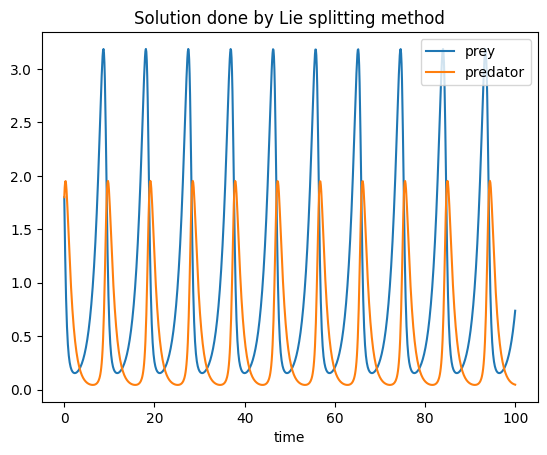
plt.plot(t_lie,x_lie,label="prey")
plt.plot(t_lie,y_lie,label="predator")
plt.xlabel("time")
plt.title("Solution done by Lie splitting method")
plt.legend()
plt.show()
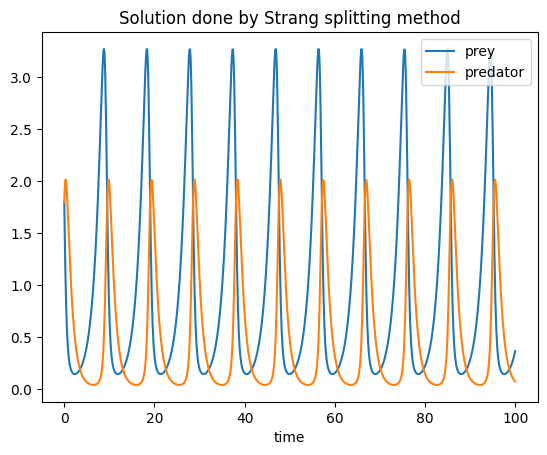
plt.plot(t_strang,x_strang,label="prey")
plt.plot(t_strang,y_strang,label="predator")
plt.xlabel("time")
plt.title("Solution done by Strang splitting method")
plt.legend()
plt.show()
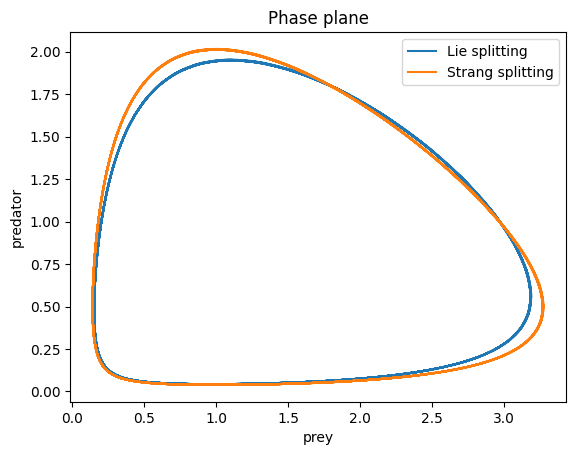
plt.plot(x_lie,y_lie,label="Lie splitting")
plt.plot(x_strang,y_strang,label="Strang splitting")
plt.legend()
plt.xlabel("prey")
plt.ylabel("predator")
plt.title("Phase plane")
plt.show()
Now define the invariant \(V\) :
def V(x,y, alpha=2./3., beta=4./3., gamma=1., delta=1.):
    return delta*x - np.log(x) + beta*y - alpha*np.log(y)
V0 = V(x_lie[0],y_lie[0])
plt.plot(t_lie,V(x_lie,y_lie)/V0-1.,label="Lie splitting")
plt.plot(t_strang,V(x_strang,y_strang)/V0-1.,label="Strang splitting")
plt.axhline(0,0,1,linestyle="--",color="grey",linewidth=1)
plt.title("Relative error on invariant $V$")
plt.xlabel("time")
plt.legend()
plt.show()